Taxi from Lech to Arosa
Private transfer from Lech am Arlberg to Arosa — 24/7, door to door, fixed price on request.
- Fixed price per vehicle
- Door to door
- 24/7 available
- Winter-ready 4×4
- Ski equipment included
- Spacious — up to 8 passengers
- Experienced local drivers
- Direct operator, not an agent
Taxi from Lech to Arosa: the price, the car and the pickup
Lech to Arosa: 157 km, around 2 hours 25 minutes.
Need a transfer from Lech am Arlberg to Arosa? We collect you at your hotel, chalet or apartment and drive you there without changes and without stops on the way — one vehicle, your group, nobody else — no shared shuttle and no waiting for strangers to be collected first.
Our vehicles are winter-ready 4x4s with ski racks and plenty of space for up to 8 passengers with luggage, driven by experienced local drivers who are on these roads every day of the season. Skis and snowboards travel at no extra charge, and child seats are fitted free.
We give you the fixed price on request — per vehicle and one way, not per person.
Leaving Lech means the Flexenstraße first
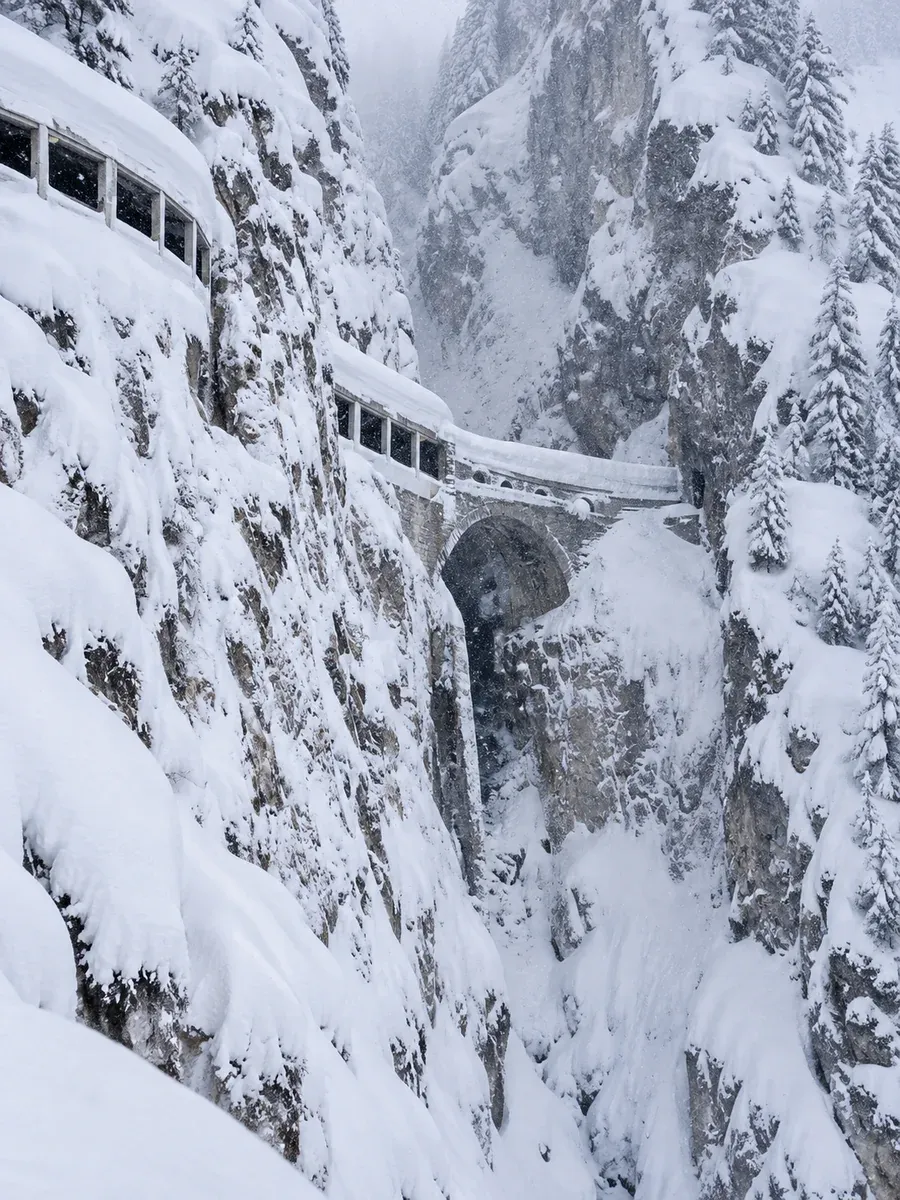
Every drive out of Lech begins the same way, wherever it is going: over Zürs and along the Flexenstraße to the Alpe Rauz, then down to Stuben and Langen. About twenty kilometres, and they are the part a distance calculator underestimates — galleries, bends and speed limits, not fast road.
When there is avalanche risk the Flexenstraße is closed, and then there is no way round. It is the only road out of Lech in that direction. Guests stay the night in Stuben, Langen or St. Anton and travel on the next morning, usually after eight, once the road opens.
That is not small print, it is the reason we set off earlier than the arithmetic needs on a long drive. We can see in the morning how the road is, and we would rather tell you the evening before to start half an hour earlier than promise an arrival time that depends on a barrier. Getting you there on time is what the margin is for, and it is the one thing a reliable transfer has to get right.
Where we pick you up in Lech
The transfer starts at your door. Where a vehicle can reach it we collect there; where it cannot, at an agreed point nearby.
- Lech village
No restricted streets here — we pull up at the hotel door like anywhere else.
- Oberlech
Three ways in, depending on the building: the Oberlechbahn valley station, the Umschlaghalle and your hotel’s own tunnel, or the whole way up by road. Reception knows which is yours.
- Zug near Lech
Reached directly, a few minutes up the valley beyond Lech.
- Zürs am Arlberg
On the road out in any case — a pickup there costs no detour.
The road on to Arosa
The way out is the usual one — down the Klostertal to Bludenz, past Feldkirch, across the Rhine into Switzerland and south through Sargans and Landquart to Chur. Those first 120 kilometres are the quick part and take about an hour and forty minutes.
Then comes the Schanfigg, and it is a different kind of road. From Chur the Schanfiggerstrasse climbs just over thirty kilometres and about 1,280 metres to Arosa — bend after bend, through three tunnels and across the big bridges over the tobels. The sign at the Arosa end puts the count at 360 bends. It is a well-built cantonal road and it is cleared every day of the season, but it takes the time it takes.
Arosa sits at 1,775 metres at the head of the valley, and the road stops there. Nothing goes on over the far side — not to Davos, not across to Lenzerheide. Everything that reaches Arosa comes up the Schanfigg, and everything that leaves goes back down it.
The Lech to Arosa route on the map
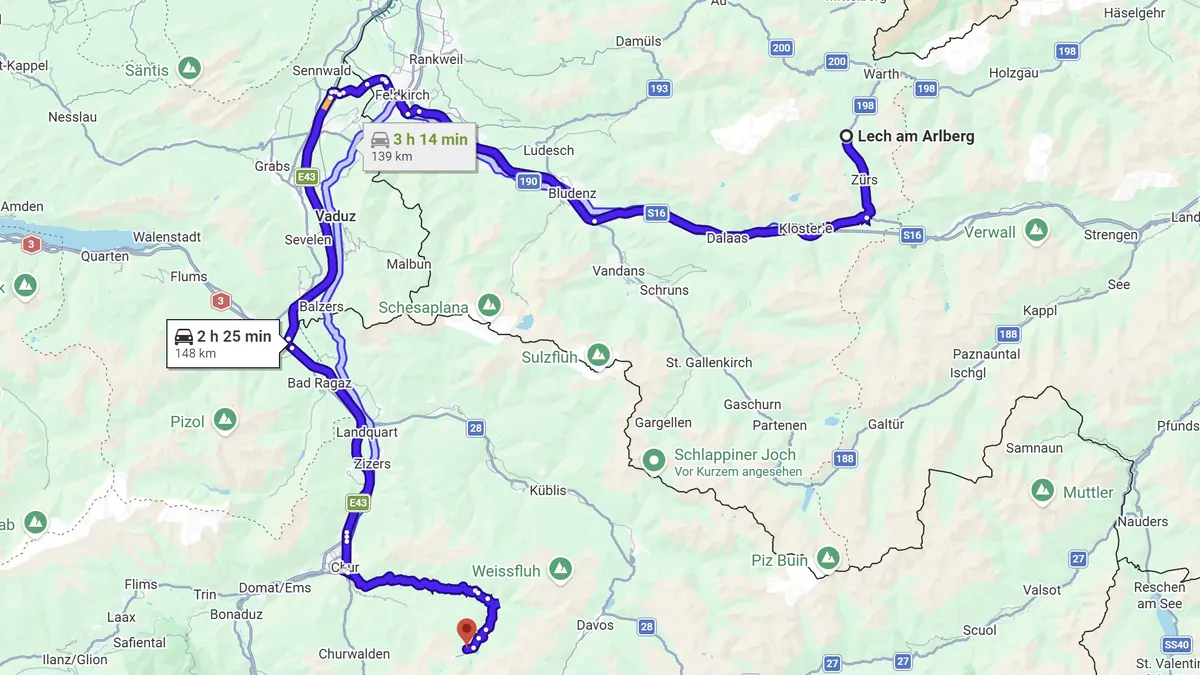
The route from Lech to Arosa, stop by stop
Read the drawing from the top and it falls into two halves with almost nothing in common. The first is quick: down the Klostertal, out past Feldkirch, over the Rhine and south along the valley through Sargans and Landquart. Motorway or main road nearly all of it, and no pass to cross.
The second begins at Chur, about 120 kilometres in. Everything up to that point has been downhill — from 1,450 metres in Lech to about 590 in Chur. The last stretch gives all of it back and more: roughly 1,280 metres of climb up the Schanfigg to Arosa at 1,775.
That is the whole explanation for the clock. Chur is 120 kilometres and about an hour and forty minutes; Arosa is 157 kilometres and about two hours twenty-five. The last quarter of the distance costs another three quarters of an hour, and it is the part worth planning around rather than arguing with.
The Schanfigg: the thirty kilometres that set the time
The Schanfiggerstrasse runs 30.6 kilometres from Chur to Innerarosa and climbs about 1,280 metres doing it. It is a proper modern cantonal road, not a track: three tunnels of 300, 370 and 425 metres, wide bridges over the tobels, and the famous Langwies viaduct alongside carrying the railway. But it is cut into a steep valley side, and it bends the entire way.
In winter it is cleared daily and driven daily — post buses, delivery lorries, everybody who lives up there. What changes on a bad day is the rule: a chain requirement is ordered from Langwies upwards, and vehicles with four-wheel drive are exempt from it. That is not our marketing; it is how the road is run.
Our cars are 4x4 and they carry chains all season in any case. The point is not the equipment list — it is that a chain order on the Schanfigg is an ordinary winter morning for us, and the end of the journey for anything that has neither.
- 30.6 km
Chur to Innerarosa — the last leg of the transfer, and the slow one.
- About 1,280 m of climb
From the Rhine valley at Chur up to 1,775 metres in Arosa.
- 360 bends
The figure on the sign at the Arosa end. It is that kind of road.
- Chains from Langwies
Ordered on bad winter days — and four-wheel drive is exempt.
Two dead-end valleys, one transfer
This is the rare route where both ends are the end of the road. Arosa has one way in and the same way out — the Schanfiggerstrasse finishes at Innerarosa and nothing continues over the mountains. And in winter Lech is in exactly the same position: the road on towards Warth is shut for the season, so the Flexenstraße is the only way out.
For a transfer that puts the margin at both ends instead of in the middle. The motorway between them behaves itself. The two climbs are the parts that can be slow, and they happen to be the first twenty kilometres and the last thirty-odd.
It also means there is no clever alternative to be found on the morning. One road out of Lech, one road up to Arosa, and the only thing left to decide is when we set off. Which is why we would rather know when you need to be in Arosa than when you would like to leave Lech — we work the pickup back from the first and tell you the second.
Arosa itself: 1,775 metres, and quiet after midnight
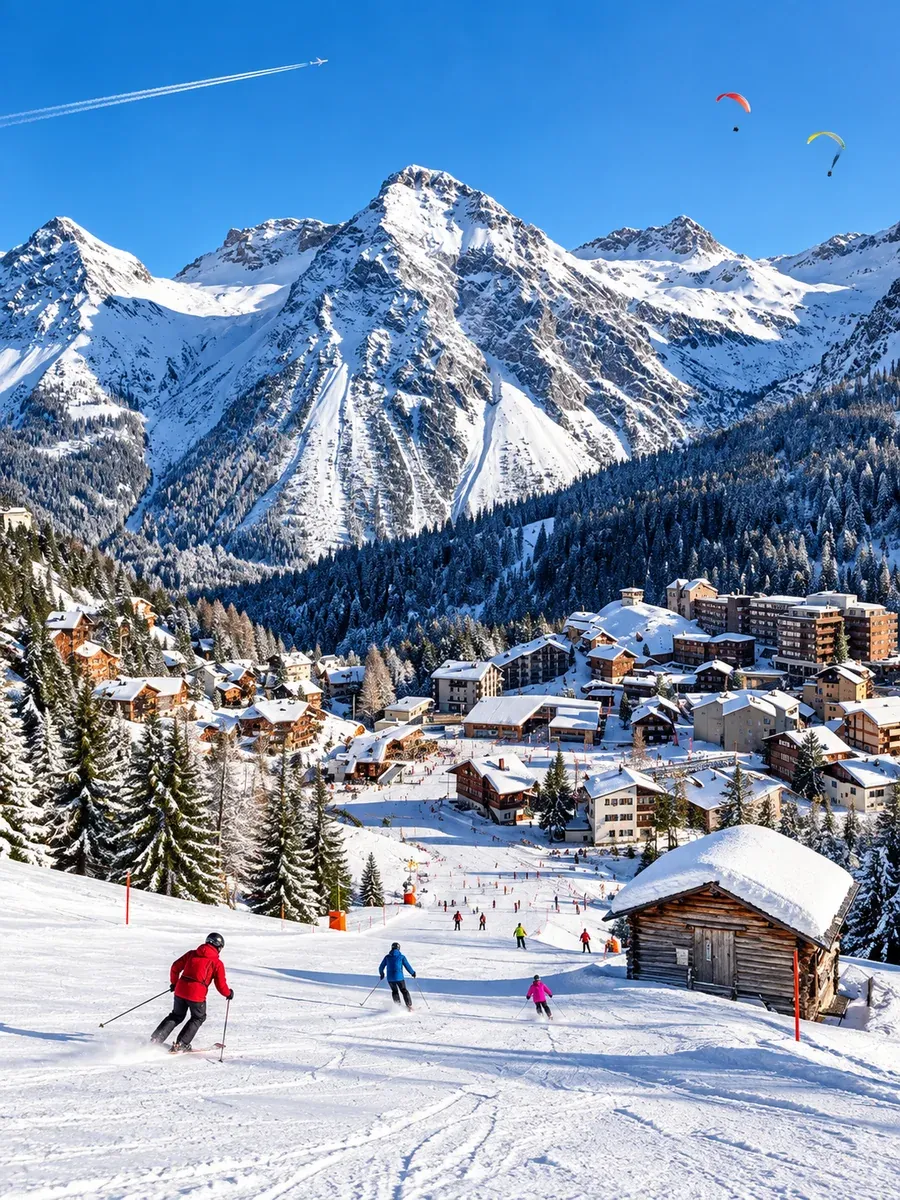
Arosa sits at 1,775 metres at the head of the Schanfigg, under the Weisshorn and the Aroser Rothorn, with two small lakes in the middle of it and the railway terminus a few steps from the hotels. It is a compact place — most of what you need is within walking distance of wherever you are staying, which is not true of every resort this size.
One local rule is worth knowing before you book a late arrival or an early departure. Arosa has a general night driving ban between midnight and six in the morning, covering the whole village. Taxis are explicitly exempt from it, and direct arrivals and departures are permitted in any case — so a transfer that reaches Arosa at one in the morning, or leaves it at five, is not a problem. That ban is also the reason the place is as quiet at night as it is.
We drive to the door wherever a car can reach it, and to the nearest sensible point where it cannot. If you are staying right at the top in Innerarosa, where the road finally stops, tell us — it is a few minutes further up and it changes nothing about the price.
Arosa Lenzerheide: one lift pass, two valleys, no road between them
Since the end of 2013 Arosa and Lenzerheide have been joined by a cable car over the Urdental and sold as one ski area on one pass. On skis you are across in minutes, and the two names now travel together in every brochure.
By car you do not cross at all. Lenzerheide lies in the next valley and is reached from Chur by a completely different road, over Churwalden — there is no way through from one to the other. So if your hotel is in Lenzerheide or Valbella rather than Arosa, say so when you ask for the price: it is a different drive, not a detour on this one.
And the pass has nothing to do with Ski Arlberg. What you bought in Lech does not work here and what you buy here does not work in Lech — worth knowing before you pay for either.
Taxi or train from Lech to Arosa?
The train to Arosa is worth the ride for its own sake. The Arosabahn has run since December 1914 — metre gauge, 25.7 kilometres — and it begins by rolling through the streets of Chur on grooved rails among the traffic before it climbs the Schanfigg and crosses the Langwies viaduct. A little over an hour, and one of the better railway journeys in the Alps.
What it cannot do is start where you are. Lech has no station, so a rail journey begins with a road transfer down the Flexenstraße whatever else you do, then a change in the valley and another in Chur. With four people, four cases and skis, that is three separate times of lifting everything on and off again.
So: two of you travelling light, with an afternoon to spend? Take the train from Langen and enjoy it — we will tell you so. A family or a group with equipment? The car that picks you up in Lech is the same car that stops outside your hotel in Arosa, and nothing you are carrying gets touched in between.
| Private transfer | Train | |
|---|---|---|
| Starts at | Your door in Lech | Langen or St. Anton — Lech has no station |
| Getting to the train | Not needed | A transfer down the Flexenstraße first |
| Changes | None | One down the valley, another in Chur |
| The last stretch | The same car up the Schanfigg | The Arosabahn, just over an hour from Chur |
| Skis and cases | Loaded once, stay with you | You carry them at every change |
| Arrives at | Your hotel in Arosa | Arosa station |
| Best for | Groups, families, ski equipment | One or two travelling light |
And back again: from Arosa to Lech
We drive the transfer in both directions, at the same fixed price. Give us the time and the address in Arosa when you ask, and a car is there for it — late at night and early in the morning included.
If you already know you are coming back, ask for both directions at once: the car is then allocated to both, and booking early costs you nothing extra.
Frequently asked questions
How much is a transfer from Lech to Arosa?
We give you the fixed price on request — per vehicle for up to 8 passengers, not per person. Send us the pickup address, the date, the time and how many of you there are, and you get the binding price back before you commit to anything.
How do I pay for the ride?
You pay the driver directly, in cash or by card — Visa and Mastercard are accepted. The price is fixed per vehicle and confirmed when you book, so you know the full amount before the journey starts.
Do you collect from Oberlech and Zug as well?
Yes. In Oberlech the meeting point depends on how your building is reached: at the Oberlechbahn valley station, at the Umschlaghalle if your hotel has a tunnel of its own, or the whole way up if the road goes there. Tell us what reception told you. Zug we reach directly.
Do you drive at night and early in the morning?
Yes, around the clock. For a departure before six in the morning, book the day before so the driver and the vehicle are already allocated.
Why does Lech to Arosa take two and a half hours for 157 kilometres?
Because of the last 37. The 120 kilometres to Chur take about an hour and forty minutes on motorway and main road. From Chur the Schanfiggerstrasse climbs about 1,280 metres to Arosa in one long series of bends, and there is no alternative road — that climb costs another three quarters of an hour.
Do you drive to Arosa in winter?
Yes, all season. The road is cleared and used every day. On bad days a chain requirement is ordered from Langwies upwards, with four-wheel drive exempt — our cars are 4x4 and carry chains anyway, so it changes nothing about whether we come, only how much time we allow for the climb.
Can you take us to Lenzerheide instead?
Yes, but it is a different drive. Lenzerheide is in the next valley, reached from Chur over Churwalden; there is no road across from Arosa, only the cable car that links the two ski areas. Tell us which of the two and we price the right one.
Does the road carry on anywhere past Arosa?
No. The Schanfiggerstrasse ends at Innerarosa and nothing goes on over the mountains — not to Davos, not to Lenzerheide. Everything arrives and leaves the same way, which is worth knowing if you are moving on somewhere else afterwards: tell us and we plan the drive back down with you.